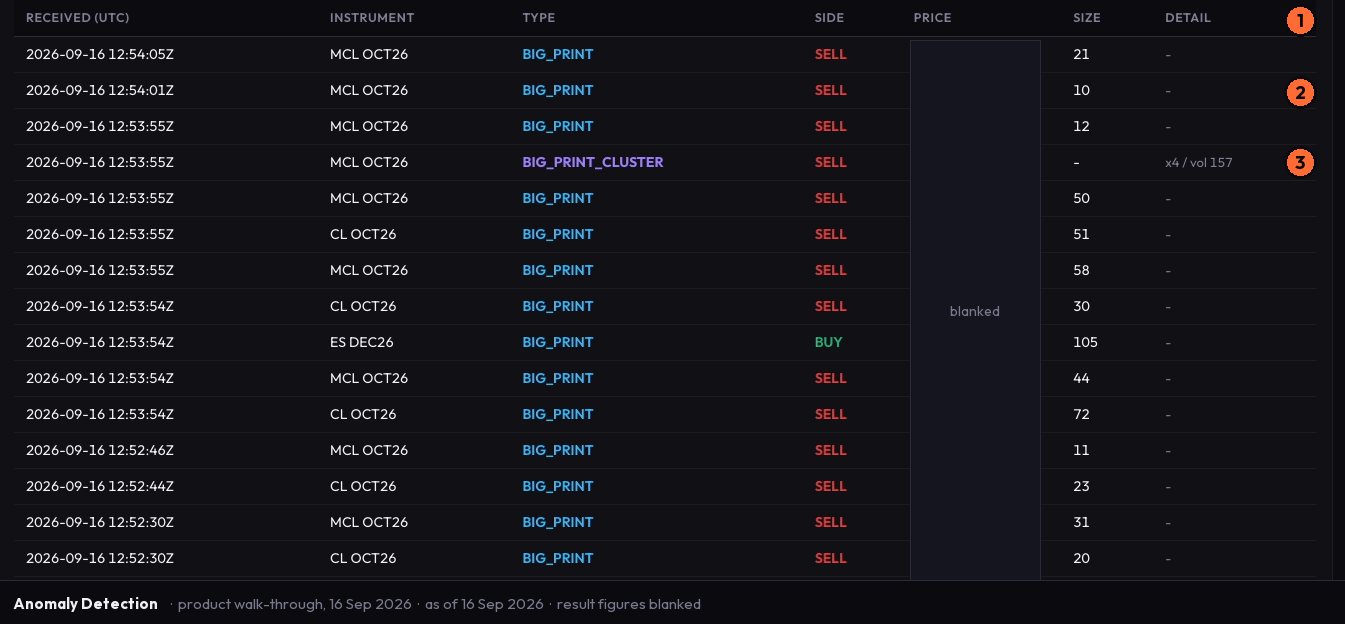
A big print is not a vibe. It is not shorthand for "something moved." It is a classifiable event: a trade far outside the running distribution of trade sizes on a specific instrument, at a specific price, with a side attached. The feed can identify it as it lands. The terminology exists because the event is real and measurable - and because the discipline of treating it that way is what separates analysis from noise.
What qualifies
Every instrument has a distribution of normal trade sizes at any given time. Most prints cluster within a range that reflects the typical participant mix - retail flow, algo slices, routine institutional execution. A big print sits far enough outside that distribution to register as anomalous. Not large in absolute terms - large relative to what is normal for that instrument right now.
That distinction matters. A print that looks large on one CME contract might be unremarkable on another. The classification is not against a fixed threshold applied uniformly. It is against the running distribution for that instrument at that moment. What qualifies is contextual. The engine does not fire on size alone - it fires when size departs meaningfully from what the feed has seen.
The output is specific: side, price, size. Not a summary. Not a category label. The exact detail of the event as it landed in the order book.
How a cluster differs
One anomalous print and several anomalous prints arriving inside a short window are different events. They are classified separately because they carry different information about the character of the order flow.
A single BIG_PRINT might be a block hedge. A single institutional order working through a thin session. A roll on a position. Isolated anomaly in an otherwise unremarkable tape. It is notable. It is not necessarily indicative of anything beyond itself.
A BIG_PRINT_CLUSTER is something else. Multiple prints, each qualifying as anomalous, arriving within a compressed timeframe. That pattern describes a different kind of pressure on the order book - repeated, concentrated, not easily explained by routine execution. The cluster classification exists because the temporal dimension adds information that the individual print does not carry.
This is not a louder version of the same flag. It is a different flag. The Anomaly Detection surface on Vulcan Trading classifies both - live, on CME contracts (MES, ES, MCL, CL) - because the distinction is operationally meaningful and collapsing it would throw away information.
What the classification surfaces
What Anomaly Detection outputs for each event: side (buy or sell), price, size, and whether what just landed was a single print or a cluster. That is the complete description of what happened in the order book at that moment.
What it does not output: what you should do next.
Those two things are not the same, and the gap between them is not a product limitation - it is the correct structure of the output. The classification describes an event. Your analysis determines what the event means in context. Whether the print aligns with or contradicts the prevailing order flow. Whether it is consistent with known positioning. Whether the instrument's recent tape makes a cluster more or less significant. None of that is inside the classification. All of it is yours to work through.
Anomaly Detection is a detection surface. It sits in the Detection and Adaptation chapter of Vulcan Trading alongside Polymarket Flow, Error Learning and Gold Bias Engine - surfaces that read the data and surface the event, not surfaces that resolve what the event means for your position.
Information versus instruction
Big prints move narratives fast. On trading desks and in communities, the phrase "a big print just hit" carries weight before anyone has asked what instrument, what size, what side, or whether it was isolated or part of a cluster. That speed is the risk.
The analytical discipline is to start from the classification, not to bypass it. Side. Price. Size. Single print or cluster. Those are the inputs to your question - not the answer to it. The Anomaly Detection surface gives you the former. What you build from it is entirely your own.
The event is information. Whether it belongs in your analysis, and what it implies there, is not something the feed resolves. That gap is not a gap in the product. It is where the work is.
Vulcan Trading surfaces BIG_PRINT and BIG_PRINT_CLUSTER events live - side, price, size and cluster detail - on CME contracts. Start free at vulcan-trading.ai.
#OrderFlow #TradingIntelligence #VulcanTrading